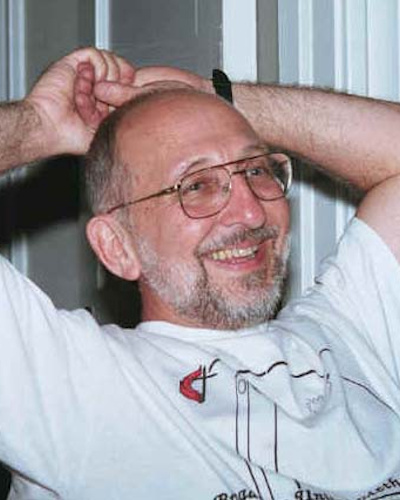
Rev. Gregory Dell
Biography
The Rev. Gregory Dell became pastor of Broadway United Methodist Church in Chicago in 1995. At the time, approximately 40% of the congregation's members were gay or lesbian. Since the 1980s, he had included holy union services for gay and lesbian couples as part of his pastoral duties because he believed a person’s God-given identity should be celebrated rather than a reason for exclusion. But his denomination struggled with the issue of homosexuality. Dell found himself caught between being responsible to his ordination vows and call to inclusive ministry on the one hand, and his denomination’s official antigay positions on the other.
Dell’s view was that in every church where he had been a pastor, “it was with the understanding that I would serve the whole church with the ministry that the United Methodist Church puts in place for clergy to offer to a congregation.” That included the church offering a blessing on a couple's commitment of faithfulness to one another and because of their relationship to the church and to God. In September, 1998, Dell decided to conduct a service of holy union for two gay men in his congregation. “I extended ministry to two men who love each other, love God and love the church.”
A gay paper published a story about the service, and a clergy person showed it to Dell’s bishop. The bishop, though he personally disagreed with the denomination’s negative position on homosexuality, filed a complaint alleging Dell had been disobedient to the Order and Discipline of The United Methodist Church.
In March, 1999, a church trial court of 13 clergy members voted 10 to 3 that Dell was guilty of disobedience. The court suspended Dell from his ministerial duties indefinitely, until he either signed a pledge to stop performing union services for same-gender persons or the church changed its policy. Dell refused to sign such a pledge. To stop, he believed, would discriminate against gays and lesbians in his congregation. Dell appealed the conviction. The appeals committee had authority only to change the punishment, not the verdict. It changed the penalty from an indefinite time period to a one-year suspension if he would not sign the pledge.
Dell’s sense of justice goes back to experiences growing up in northern Illinois and in his pastoral development. He flirted with the idea of becoming a minister in the eighth grade, and got a license to preach in the Methodist Church. He had been an Eagle Scout and was thinking about pursuing scouting professionally. He was interested in providing support and guidance for young people. But he also had a deep desire to work for justice, reflected in activities regarding issues of race and South Africa.
He was influenced by a pastor who encouraged him to think about the ministry. The pastor helped shape Dell’s understanding about faith. Either there is a God of all reality, including the political and economics; or a God of only part of reality, such as prayer life and scriptural study. Dell said, “It’s incomprehensible to put something outside of God’s care.” He also learned that Jesus’ ministry was always affirming God’s love and care for creation. “Social justice is not an option, social justice is part of the gospel,” says Dell. “It meant you take a stand against racism or any other injustice. It’s a matter of faith.” When he was 17 or 18 years of age, he decided to become a pastor. Dell earned his Bachelor of Arts degree at Illinois Wesleyan University and a Master of Divinity degree from Duke Divinity School. He was appointed pastor at churches in several Illinois communities before going to Broadway United Methodist Church.
During his ministry, Dell became increasingly involved in social justice issues: Third World concerns, race, gender, and eventually issues involving sexual orientation. Early on he saw that people were being oppressed because of their racial identity. So as other issues arose, like equality of women and sexual orientation, he concluded it was reasonable to affirm and celebrate their identity.
The United Methodist Church had always been a home for Dell, his faith community. Although there was not always agreement on tactics and strategy, he saw his church as committed to social justice. On identity issues such as race and gender, it taught that identity should not be used as a criterion of discrimination. But when it came to sexual orientation, he felt the church had violated its call to be inclusive.
During the one-year suspension, Dell continued to work for social justice within his church. At his denomination’s 2000 General Conference, he joined in nonviolent civil disobedience in protest to some of the body’s legislative decisions, resulting in two arrests. He became executive director of an organization called In All Things Charity. Dell remembered someone in the Religious Right commenting that since they had convicted Dell, now he would be doing full-time what he had been doing part-time.
Dell was reinstated to his pastoral duties at Broadway in July, 2000. He became involved in a movement called Church Within a Church, which plants new congregations that are full justice ministries.
On issues of social justice, Dell calls himself a radical rather than a reformer. “A radical goes to the root for what is going on, a reformer is simply trying to adjust this,” says Dell. “Reform is too often a way of compromising where people’s lives are, or their rights. You can’t compromise people’s worth, integrity.”
Following an extended illness brought on by Parkinson's Disease, Dell died on October 30, 2016, in Raleigh, North Carolina, where he had moved with his wife Jade.
(This biographical statement edited from an article by Larry Washburn who conducted an interview with Greg Dell on February 28, 2005. )
Biography Date: March, 2005
Additional Resources
This obituary was published in United Methodist Insight:
http://um-insight.net/in-the-church/ordained-ministry/champion-of-inclusion-rev-gregory-dell-dies/
The Chicago Tribune published this story by columnist Mary Schmich following Dell's death:
http://www.chicagotribune.com/news/columnists/schmich/ct-greg-dell-mary-schmich-1102-20161101-column.html
Archival Collections:
Tags
Methodist (UMC, United Methodist Church) | Activist (religious institutions) | Ally | Church Trials | Clergy Activist | Marriage Equality | Chicago | Illinois | Dell, Gregory | In All Things Charity
Citation
“Rev. Gregory Dell | Profile”, LGBTQ Religious Archives Network, accessed April 17, 2024, https://lgbtqreligiousarchives.org/profiles/gregory-dell.
Remembrances