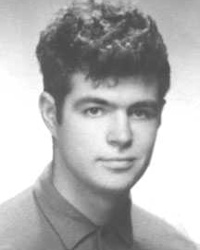
Stephen Donaldson
Biography
Writer and activist Stephen Donaldson was born Robert A. Martin, Jr. on July 27, 1946 in Norfolk, Virginia. The son of a career naval officer, his childhood was spent in numerous seaport cities of the eastern United States, as well as in Germany. His parents divorced when he was seven years old, and he lived for periods of time in a boarding school and with his grandparents. While attending high school in Long Branch, New Jersey, Donaldson acknowledged his sexual attraction to a male classmate and shortly afterwards decided to "come out" as gay. In the summer of 1965 he ran away from his mother's home in Florida to New York City, where he met leaders of the Mattachine Society of New York, an early gay rights organization. Attracted by the relatively permissive sexual atmosphere of New York, he enrolled at Columbia University.
As a college student, Donaldson was a founding member of the Student Homophile League (later re-named Gay People at Columbia-Barnard) and was active in the North American Conference of Homophile Organizations. He was a participant in the spring 1968 student uprising on the Columbia campus. Donaldson worked during his college summers as a reporter for the Associated Press and Virginia Pilot and as a legislative intern in the offices of U.S. Representatives Howard H. Callaway (Republican, Georgia) and Donald E. Lukens (Republican, Ohio). He also traveled widely across the United States, often as a hitchhiker. In diary entries and letters written during these years he described his political radicalization, his experiments with marijuana and LSD and his sexual encounters with men and women. Inspired by many aspects of the sexual revolution of the late-1960s, Donaldson increasingly identified himself as bisexual. He began to publish short articles and poems in gay publications, occasionally under the pen name Stephen Donaldson. (Though he never legally changed his name, he increasingly chose to identify himself by this pseudonym, particularly during the 1980s-90s.)
After his 1970 graduation from Columbia, Donaldson enlisted in the U.S. Navy. He shipped to Italy, where he served as a radioman on a NATO base. At this time Donaldson also became a practicing Buddhist and explored the religious traditions of the Society of Friends, also known as Quakers. In 1971 the Navy announced its intention to release him by General Discharge on grounds of suspected homosexual involvement. Donaldson mounted an unprecedented public campaign against his discharge, and won the support of U.S. Congress members Bella Abzug and Edward I. Koch. Though he lost this fight and was released in June 1972, he later won an upgrade to Honorable Discharge.
Donaldson settled in the Washington D.C. area and worked as Pentagon correspondent for the Overseas Weekly, a privately owned newspaper distributed to American servicemen stationed in Europe. He became increasingly active with the Quakers, and would eventually lead the group's bisexual caucus. In 1973 he was arrested at a Quaker peace protest at the White House, and was subsequently raped by inmates in the Washington D.C. jail. This experience, and incidents which occurred during later stints in prison, led to his outspoken activism on the issue of sexual victimization of male prisoners, most notably with the organizations People Organized to Stop the Rape of Imprisoned Persons and Stop Prisoner Rape.
From 1974-77 Donaldson did graduate work in religion at Columbia University, and served as Chairman of the Student Governing Board of the Earl Hall Center for Religion and Life. In May 1976 he was ordained as a novice monk in the orthodox (Theravada) Buddhist Order. During the late-1970s Donaldson worked intermittently as a developer of war simulation games and immersed himself in New York's punk rock subculture, centered on the CBGB nightclub in downtown Manhattan. Several personal tragedies, including the 1976 suicide of his mother, contributed to bouts of psychological depression. In March 1980, poverty-stricken and ill, Donaldson was arrested in a Bronx Veterans Administration hospital on a charge of assault with a dangerous weapon. He was convicted on other felony counts and served nearly four years in federal prison. Donaldson was paroled in April 1984, and settled again in New York City.
During the 1980s-90s, Donaldson volunteered as a counselor to male victims of sexual assault, and spoke out publicly in a wide variety of forums on the issue of prisoner rape. In 1987-88 he visited India and was there initiated in the Veerashaiva tradition of Shaivite Hinduism. This trip constituted a parole violation, and resulted in another term in federal prison during 1990. In 1992 Donaldson visited Europe to meet punk rock musicians and fans and to lecture on the American punk scene. Throughout this period he advanced his career as an editor and writer. His short essays on such topics as punk rock, prison conditions, Buddhism and sexuality appeared in numerous magazines and underground publications, often under the byline "Donny the Punk." Donaldson was assistant editor of the Encyclopedia of Homosexuality (1990) and co-editor, with Wayne Dynes, of the thirteen-volume Studies in Homosexuality (1994). During his last years he served as editor-in-chief of the Concise Encyclopedia of Homosexuality, a major revision of the 1990 Encyclopedia. His publisher cancelled the project just a few months after the manuscript was completed. Stephen Donaldson died of an AIDS-related illness in New York City on July 18, 1996.
(This biographical statement written for the Stephen Donaldson Collection, Manuscripts and Archives Division, Humanities and Social Sciences Library, New York Public Library, Astor, Lenox and Tilden Foundations. All rights reserved.)
Biography Date: September, 2005
Additional Resources
Stephen (as Robert Martin) is in these photos from a September 8, 1973 rally, "Tear Down the Walls," in Washington, D.C.:
Archival Collections:
Tags
Buddhist | Hindu | Gay Liberation Movement | U.S. Military | Donaldson, Stephen | Friends/Quakers | Mattachine Society | Author/editor | Bisexual activism | New York | New York City | Washington, D.C.
Citation
“Stephen Donaldson | Profile”, LGBTQ Religious Archives Network, accessed April 16, 2024, https://lgbtqreligiousarchives.org/profiles/stephen-donaldson.
Remembrances