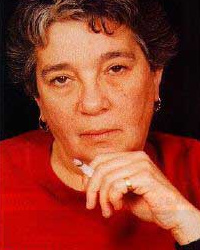
Rabbi Sheila Shulman
Biography
Rabbi Sheila Shulman was born in Brooklyn, New York, in 1936 into a largely Yiddish-speaking environment, though many folk in her parents’ generation were so anxious to become "American" that they ended up in a cultural vacuum. Sheila discovered books early on. Her formal primary and secondary education was lamentable, but there was always the library. There was also a summer camp, to which she was sent for six or seven years because her mother was a working widow and there were scholarships available. There she discovered the countryside, left-wing idealism, folk and classical music.
Through the good offices of a counselor at that camp, Shulman was encouraged to apply to Bard, a remarkable small residential college in the Hudson River Valley. She was able to go only because "they took a chance on me and awarded me a full scholarship." Shulman found the four years at Bard to be revelatory, if often painful. Culturally speaking, she had made a quantum leap. There were great teachers, she found good friends, a whole world of books, and incredible natural beauty. She notes her reflection that she was the only student in her class who wept at graduation--she never wanted to leave.
Shulman earned an MA degree in English and Comparative Literature in the 1960’s at the City University of New York and did most of the work toward a Ph.D. She traveled to England in the first instance on a fellowship in 1967, went back to America for two years to teach at a college not unlike Bard, then returned to England and has been in London ever since. She spent the 1970’s and early 80’s as an activist in the Women’s Liberation Movement, supporting herself with exiguous part-time work.
Shulman's turn toward the Rabbinate was the result of a number of factors: a mid-life reappraisal of who she was and where she was going, intellectual curiosity, metaphysical longings, religious questions, political dissatisfaction, a real love of being a Jew, a desire to work to some real purpose at the top of her bent as all of who she was. She was encouraged by an unlikely trio of Rabbis Jonathan Magonet, Lionel Blue, and Albert Friedlander. She began to train at Leo Baeck College in 1984 where she and Elizabeth Tikvah Sarah were the first openly lesbian rabbinical students. She notes that she did not for a moment believe she would ever be ordained until she was standing on the bimah on the day in July, 1989. Since ordination she has served with Finchley Reform Synagogue--initially part-time, then for a number of years as half-time Associate Rabbi, then part-time again. She has also been teaching at Leo Baeck College-Centre for Jewish Education, as a part-time Lecturer in Jewish Thought.
Soon after ordination, following a conversation with Rabbi Lionel Blue regarding the perplexities about finding work as a Lesbian Rabbi, Shulman and a group of friends founded Beit Klal Yisrael in 1990. A box on the back of their newsletter describes them as follows: "BKY welcomes everybody, but especially Lesbian Jews and gay Jews; Jewish women who want to work out an independent and challenging relationship, as women, to Judaism and being Jewish; Jewish men and women who may not think of themselves as formally religious, but who do have Jewish issues, questions and concerns; Jewish women and men whose partners, though not Jewish, wish to be supportive and to participate in the life of the congregation; Patrilineal Jews; people on their own, whose presence is truly valued." BKY has been a small but lively community where many people have found a real Jewish home. Five Rabbis currently serving other communities and one student Rabbi have come out of this community.
Rabbi Sheila Shulman died on October 25, 2014.
(This original biographical statement provided by Rabbi Sheila Shulman.)
Biography Date: December, 2005
Additional Resources
Rabbi Sheila Shulman recorded this interview with the Rainbow Jews project in the U.K.
http://www.rainbowjews.com/rabbi-sheila-shulman-a-true-pioneer/
Tags
Jewish (ethnic, Reform, Reconstructionist, Orthodox) | Blue, Lionel | Sarah, Elizabeth Tikvah | Author/editor | Clergy Activist | Women and Religion | United Kingdom
Citation
“Rabbi Sheila Shulman | Profile”, LGBTQ Religious Archives Network, accessed April 19, 2024, https://lgbtqreligiousarchives.org/profiles/sheila-shulman.
Remembrances