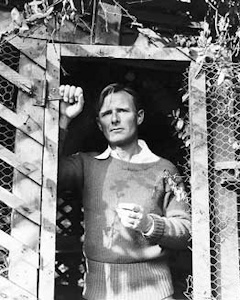
Christopher Isherwood
Biography
Christopher William Bradshaw-Isherwood (1904-1986) was born in Cheshire, England, on August 26, 1904, to Kathleen Machell-Smith and Frank Bradshaw-Isherwood. Frank was in the British military and was killed in 1915 in a battle in France. Christopher was enrolled in St. Edmund's boarding school beginning in 1914, where he met W. H. Auden who became a life-long friend and colleague. After being asked to withdraw from Corpus Christi College, Cambridge, in 1925, Isherwood began working as a secretary in London and writing novels. His first novel, All the Conspirators, was published in May, 1928.
In 1929, Isherwood joined Auden in Berlin, trying to escape the social and sexual inhibitions he felt in England. While in Berlin, he published his second novel, The Memorial (1932), and his best-known work the Berlin Stories (the basis for the musical Cabaret). While Isherwood was enamored of the lively gay culture and bohemian nature of Berlin in the early 1930s, he was also greatly troubled by Germany's slide toward facism. His writing in this period captures the despair so prevalent in German society.
To avoid the growing intolerance that Hitler was forcing on Germany, Isherwood and his German lover, Heinz, traveled around Europe for several years looking for a place to settle. Heinz was forced to return to Germany to serve in the army in 1937. Isherwood then set out for East Asia with Auden. They visited the U.S. on their return to England in 1939. Sensing that war was about to break out in Europe, Isherwood and Auden moved to the U.S. in 1939--Auden settling in New York and Isherwood in California. Isherwood pursued his own writing and publishing as well as writing scripts for the motion picture industry for most of the rest of his life.
Isherwood had rejected Christianity as a young man. Soon after moving to Santa Monica in September, 1939, he was introduced to Swami Prabhavananda, a Hindu monk of the Ramakrishna Order and founder of the Vedanta Society of Southern California. Isherwood studied with Prabhavananda and learned meditation from him. In 1943, Isherwood moved into the Vendanta Center in Hollywood, intending to become a monk. Already an acclaimed writer, Isherwood worked with Prabhavananda on creating new English translations of Hindu texts, including the popular Bhagavad Gita: Song of God. Isherwood decided to leave monastic life in 1945. However, the Vedanta Society continued to serve as the spiritual foundation for his social beliefs and his sexual identity. Among his many published writings over the rest of his life, he co-wrote or wrote these books about Hinduism: Vedanta for the Western World (1944), Shankara's Crest (1947), Vedanta for the Modern World (1951), How to Know God (1953), Approach to Vedanta (1963), Ramakrishna and His Disciples (1965), My Guru and His Disciples (1980).
Isherwood met Don Bachardy in 1953. Although Bachardy was 30 years younger, they became lovers in 1954 and remained together until Isherwood's death on January 4, 1986.
(Information for this biographical statement taken from: biographical sketch to the Christopher Isherwood Collection at the Harry Ransom Humanities Research Center at the University of Texas Austin; "Isherwood at 100" by Stephen Motika in The Palisadian-Post, August 26, 2004; the web site www.adherents.com; and from the Authors' Calendar at www.kirjasto.sci.fi.)
Biography Date: May, 2006
Additional Resources
Profiles:
Tags
Hindu | Author/editor | Isherwood, Christopher
Citation
“Christopher Isherwood | Profile”, LGBTQ Religious Archives Network, accessed April 26, 2024, https://lgbtqreligiousarchives.org/profiles/christopher-isherwood.
Remembrances